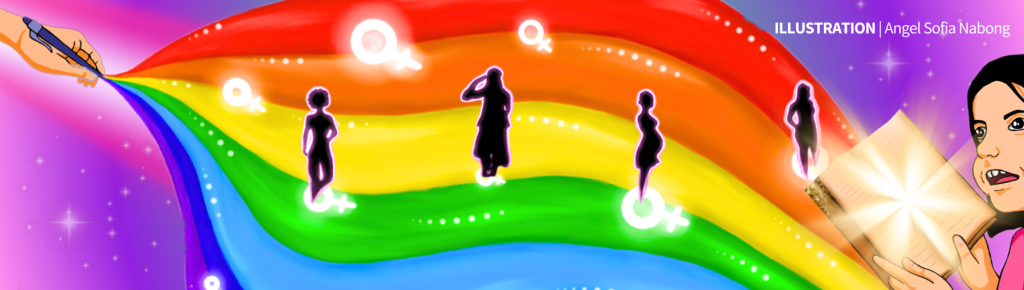
Ink stains of the past mingle with bloody narratives against patriarchy and materialism, as a literary bond forged from conflict now mingle with the struggle for freedom that is enlivened by writers to this day.
The Philippines is yet to see progressive politics and feminist initiatives on the forefront. Amidst all, literature became the vehicle of struggle. Lyrical pages became odes of resistance, seeking freedom from the wounds of a colonial past. Liberating the Filipino writer is not written in milk and honey; it is dipped in struggle and blood.
Early Filipino militant literature dwelt on heroic narratives that were passed down by word of mouth — epics, poems, stories of homegrown heroes defeating foreign conquerors.
However, the bloody conquistadors of the past have now evolved into the exploitative nature of power-hungry elites and conservative leaders who seek to retain power into the hands of the few instead of empowering the masses. Keeping enlightenment under the measure of self-interest instead of illuminating ordinary Filipinos — and holding virtues and values that contradict a long-standing tradition of national autonomy and progress, for the sake of keeping unity with the past.
This challenge, indeed, for the Filipino militant writer is to shed light into the dire conditions of their fellow citizens, that from the long-held traditions of resistance against the enemies of the nation, who are now fellow citizens who rob their people of opportunities for life, liberty and progress.
Literature for liberation
Philippine literature has developed itself into a time-tested tool to convey narratives that liberate Filipinos from antiquarian ideals. In the 1970s, speaking out led to being in grave danger. Militant literature then had to dwell into the vines and florets of literary discourse, spelling criticism in cursive letters and showcasing stark realities into thinly veiled papers.
This growing era of criticism thus bore the fruit of Filipina feminist writers such as Lorena Barros, who saw the revolutionary drive from the eyes of women and sought to spread the seeds of social awakening through the narratives of liberation, a narrative taken up by generations of Filipinos: her literary siblings and heirs.
Ma. Lorena Barros, was a self-made writer, contributing poet and essayist in various publications and former president of the UP Writers Club who married the militant writer into her contemporary literary scene.
Being an anthropology graduate from the University of the Philippines, she was drawn into depicting the narratives of women and was immersed in the emerging political literature of the late 60s — leading the all-women group Makibaka (Malayang Kilusan ng Bagong Kababaihan) while defying the stereotypical image of a woman activist in the Martial Law era.
Her biography from the Bantayog ng mga Bayani explicitly reflects her vision of radical femininity: embracing her features with love while championing radical ideals: “She did not repress her natural charm and kindheartedness, and she was proud of her long shapely legs.”
She was a prolific Filipina advocate, revolutionary poet and fiery writer, where literature was never an apolitical matter. Her depiction of the Filipina woman in her writings were verses that are born to resist the shackles of a culture of impunity, incompetence and exploitative values.
Barros highlighted in her poem The Documentary of a War as hints of women being the heroes, women saving not only pots, pans and children but also the wounded legacy that exploitative wars have left behind, like the political atmosphere of the 60s that have left bloodshed into the hands of revolutionaries.
She writes, “Women as women will try to save, As much as can be saved of pots and clothing. We cannot leave Do not make us leave our ancestors, to a prayerless village.”
A stark reminder that guns don’t only define war, it’s also the loss associated with it, the violence and scars inflicted against women who seek to have independence from conflict.
Transformative, indeed, was her writing that shifts a crack into the literary locus of Maria Clara, a niche that has kept the Filipina in the shade of the patriarchy needs to be shattered by the overturning of bourgeois education — instead of glorifying property and achievement, national integrity and empathy towards the marginalized should define the new Filipina.
This revolutionary persona, in fact, reflects a later poem that Barros wrote in her later years — Yesterday I Had a Talk, stating, “You have endured the first minute of your own dark season — Ah, I can bear to think of it only when I can see your smile! Comrade, dear friend, teach me how not to flinch through mine.”
Staying steadfast to the militant ideal has always been a matter of equity for Barros, a participatory approach that brings women out from the sidelines and into the forefront of revolutionary discussions.
In a quote published by the Center for Women’s Resources, Barros highlighted the role of the new Filipina to be a beacon of solidarity, one who could stay at length with striking workers and social realities that have been locked up by the bourgeois educational system and feudal family values, transforming the idea of a woman with respect in the home to a respectable woman in the public sphere.
“She is a woman who has discovered the exalting realm of responsibility, a woman fully engaged in the making of history.”
It is her vision that literature should go and touch the experiences of people on streets and strikes, highlighting that the goal of writing is never to please the upper classes by flamboyant words, but shake society up in brandishing stark realities — a legacy taught by militant writers from the ‘70s until today.
Radical Love Reborn
A lineage of writers blazing with feminist flames was then born in Philippine society, with the brand of radical feminism bleeding into the pages of Dekada ‘70 by Lualhati Bautista.
From the raging ideal of Barros’ poetry, Bautista highlighted the interior struggle of Filipina mothers against a colonially enabling and patriarchal society. her female characters in Dekada 70 and Bata, Bata, Paano ka Ginawa? — works that descended not only from the printed page but also through the silver screen showcased not only characters who were willing to die in armed conflicts, but were Filipinas imbued with the soul for the struggle.
Bautista showered the idea of radical love in her works, with mothers and lovers being caught in a crossroads of struggle, while challenging the gender based components that defined Filipino society by the time of a tumultuous and revolutionary period in Manila.
Amanda Bartolome, from the novel towards the film edition, clearly showed that the loss of her son– from the initial shock of discovering her child’s involvement with the revolutionaries towards empathizing with the greater social struggle of peasants and working class is a clear testimony of femininity.
Clearly, a woman can indeed describe her femininity and embrace it with headstrong courage: that a lover does not need to be weak, nor a mother share passively in her son’s struggle.
“Hindi pala natatapos ang hirap at kirot sa pagsisilang ng anak, may mga sakit na libong ulit na mas masakit kaysa mga oras ng panganganak. Bakit gano’n, hindi mo maangkin ang mga dinaramdam ng anak mo. Bakit gano’n, wala kang magawa kundi iyakan ang mga pagdurusa niya!”
The veil of Filipina genteel minds has now been shattered, and as the third wave of global feminism tore through the Philippines, illusions of domestic tranquility now shatter in the challenge to gain bodily autonomy, something that is currently fought for not only by women, but also by the Filipino feminist movement, which seeks equality not only through tokenistic initiatives, but by displaying people’s struggles.
Bautista expressed recently one of her most iconic lines, now worn on a piece of clothing, stating, “Sundin ang tibok ng puso. Sundan ang sariling bahaghari” — to follow one’s heart and diverse colors represents a struggle that has permeated Filipino artists to create and combat narratives, diving into the core and center of bodily politics and autonomy.
People’s struggles against an oppressive system has made the field of militant literature to become the next battleground of narratives in the fight for gender equality — displaying the rage of women that shall never be silenced.
Queer Tears and Ink Stains
Genuine revolutions in literature does not end, however, in the pens of combatting Martial Law, it also lives in dismantling the legacy of not only historical revisionism, but also of gender-based struggle.
The fight for national liberation in the social scheme continues to confront the social hierarchy perpetuated by generations of conservative “Filipino” values, a ceiling that now seeks to be broken by LGBTQIA+ artists such as Professor Danton Remoto, who specializes in the literary arts, as well as Jay Altarejos, a film maker that seeks to portray genuine love that breaks the gender structure and strata in the Philippines is indeed possible — a vision that the 70s was only starting to wake up.
Remoto’s Riverun is not only the first gay awakening novel in the Philippines, but he also takes on a new ideal of breaking the gay stereotype in the Philippines, one that he has performed literary criticism of in the early days of the COVID-19 Pandemic.
The novel narrates a quasi-biographical image of Remoto’s life, having the story led by Danilo (Danny) Cruz, who grew up in the early 70s near a military base while dealing with social upheaval, unrequited love, scattered emotions and an overarching shadow of repressive norms — in a nation that boxed in the LGBTQIA+ community into stereotypical niches instead of showing opportunities towards self-actualization.
Remoto also considers the rise of Boy’s Love (BL) stories as reminisces in the struggle to redefine the LGBTQIA+ community beyond comic relief as well as break the stereotypes of ideal of portraying Filipino gays as solely feminine.
“Gone are the swishy characters who are brainless, those stereotyped gays who are objects of fun. Now, we have young intelligent men. But of course, they focus on straight-acting men. That’s why it’s really a fantasy. But fantasy has a role in everyday life. These BL shows have helped a lot of people during the pandemic, ”he said in his blog page.
Remoto’s idea of liberalizing the BL scene to dismantle stereotypes and allow the narratives of LGBTQIA+ Filipinos to permeate the mainstream has also seen director Jay Altarejos, who paints narratives into the idea of cinema — where the silver screen overcomes the conflicts related to shame.
His films, such as Ang Lihim ni Antonio, vanquishing the shadows of a reinforced Filipino ideal of the closet, or the Tale of the Lost Boys, which deals with a communitarian recognition of one’s genuine identity, holds the idea that LGBTQIA+ Filipinos indeed struggle in their daily survival, where recognition of their identity holds paramount in the lens of today’s readers — a piece de resistance of romance amidst a ferociously cramped social sphere.
Reinvigorated, Militant, and Real
The fiery page is indeed both feminist and queer, with revolutionary writers and introspective queer communicators fighting a battle against their narratives being erased and repressed by a dominant conservative society.
Through the liberation of the pen, critical minds will now fight conservative narratives such as the commodification of women or the branding of the queer body and soul as inherently disordered — narratives that will be dismantled by the power of feminist and queer literature with its empowered authors.
This radical lineage of writers is yet to reach its golden years, yet the fight continues on to reclaim the wounded soul of the country towards embracing its most vulnerable citizens who seek to rise in action.
Despite previously being shut down from the mainstream, feminist and queer literature now thrives in reading circles, magazines and digital formats, being accessible to the ordinary Filipino in these accelerated times.
Lorena Barros once said, “The new woman is first and foremost, a militant.” With a literary saga born out of the militant efforts to liberate Filipinos from the shackles of being bled, bruised and burnt through ink stains that mar a renewed Filipino conscience.
For today, the future of literature is free, feminist and queer, and the fire of radical writing blazes through the Filipino soul, one page at a time.

 SENTRO
Leave a comment