
Inspired by philosopher David Hume’s exploration of implicit submission — the notion that governments are founded solely on opinion and the silent submission of the governed — Suzanne Collins dives into the power of propaganda and how narratives are sculpted by those in power to maintain control in “Sunrise on the Reaping”, the fifth installment in The Hunger Games book series.
Set 24 years before the original trilogy, the novel exposes how the Capitol, the seat of power in Panem, strategically bends reality to their will by meticulously editing the Hunger Games footage and distorting history. Collins also hints at the terrifying potential of artificial intelligence (AI), a force so dangerous that even the Capitol itself fears its unchecked power.
The story unfolds through the eyes of Haymitch Abernathy, District 12’s second victor and eventually mentor to Katniss Everdeen and Peeta Mellark. It begins on his 16th birthday, the same day when 48 children — including him — are reaped from the 12 districts of Panem to fight to death in the 50th Hunger Games or the Second Quarter Quell. Unlike Katniss’ defiant blaze in the original trilogy, Haymitch’s story is marked by brutal manipulation — not just of his fate in the arena, but of how that fate is remembered.
Haymitch’s rebellious acts during the Games, including his attempt to destroy the arena, are systematically erased from the tapes of the 50th Hunger Games. The Capitol, under the iron-fisted rule of President Coriolanus Snow, maintains a tight grip on the media — allowing them to completely alter his image. What was once rebellion is recast as recklessness, defiance becomes self-serving, and his actions are distorted to portray him as a “jackass rascal” — a caricature designed to neutralize any threat he might pose. Even Katniss, when watching the heavily edited tapes of Haymitch’s Games in “Catching Fire”, sees him as a troublemaker.
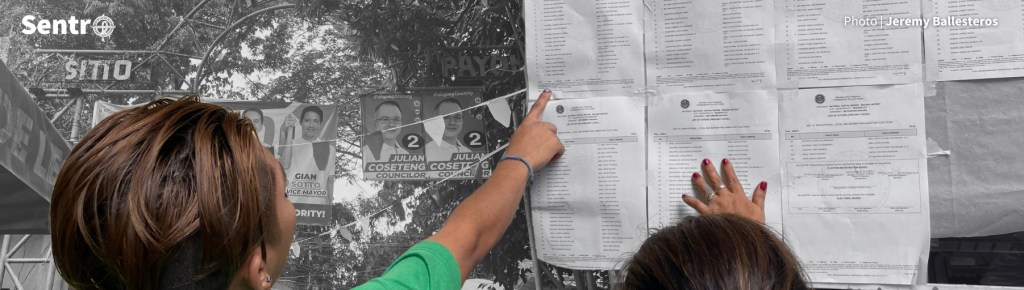
This control and manipulation of information is not just a work of dystopian fiction. In Philippine politics, especially during elections, propaganda and narrative control have been wielded just as strategically.
Following former President Rodrigo Duterte’s arrest and transfer to the International Criminal Court (ICC), a sophisticated network of fake social media accounts emerged to defend him. Research revealed that about a third of the accounts praising Duterte and lambasting the international court were fake, dubbed as a “deliberate, organized” campaign to shape public opinion.
These accounts were so meticulously created that they became indistinguishable from real people, amplifying pro-Duterte narratives and aggressively attacking dissent. Despite this, Duterte, who was also running for mayor of Davao City in the 2025 elections, saw a landslide victory.
The Capitol’s grip on the narrative reaches back into the past by rewriting history to serve its agenda. Haymitch reflects on Panem’s collective amnesia regarding Lucy Gray Baird, the victor of the 10th Hunger Games and the first from District 12. Her existence is almost entirely erased, not just from Capitol records but even from the memories of her own district. As Haymitch recalls,
“In fifty years, we’ve only had one victor, and that was a long time ago. A girl who no one seems to know anything about.”
Her story is so thoroughly scrubbed from history that even in her own hometown, she has been reduced to a ghost — a rumor barely remembered. This erasure is a form of control. If no one remembers the victory, the inspiration, or the defiance, then rebellion dies before it begins.
This rewriting of history — or historical distortion — feels hauntingly familiar during the last presidential elections. Political figures are rebranded, and eras of authoritarian rule are redefined as periods of prosperity. Social media campaigns, bolstered by troll farms and disinformation networks, spread these altered histories, blurring the lines between fact and fiction.
During the 2022 national elections, fact-checking initiative Tsek.ph found that President Ferdinand “Bongbong” Marcos Jr., son of the late dictator Ferdinand Marcos Sr., reaped the benefits of strategically misleading social media posts. University of the Philippines journalism professor Yvonne Chua said in a Senate Hearing that over 200 fact checks were curated by early February of the same year, revealing a relentless spread of historical inaccuracies, glorifying the era of the late dictator and whitewashing the realities of Martial Law.
The disturbing potential of AI and deepfakes in propaganda were also given light. Collins hints at its dark possibilities through Plutarch Heavensbee — former cameraman and future Head Gamemaker of the 75th Hunger Games — as he reflects on an outlawed technology capable of “replicating any scenario using any person… And in mere seconds!” Lou Lou, a body double created by the Capitol after the death of Louella McCoy, one of the four District 12 tributes, serves as a metaphor for the uncanny precision of AI — an imitation so lifelike that only those who knew the real Louella could sense the difference. Haymitch observes,
“She sure looks like Louella. Same size, same height. Heart-shaped face, big gray eyes, long dark braids… But this isn’t Louella.”
Haymitch knew the truth because Louella died in his arms during the tributes’ parade. But for the rest of Panem, Lou Lou was real enough. Real enough to believe. Real enough to manipulate.
While Panem’s technology is fictional, its real-world counterpart is not. In the lead-up to the 2025 Philippine midterm elections, political analysts sounded the alarm over the Philippine’s vulnerability to deepfakes, warning that the country is ill-equipped to combat the misuse of AI by political candidates seeking to undermine the integrity of the vote.
These warnings proved justified. AI-generated propaganda soon surfaced, with Ang Probinsyano Partylist deploying AI-generated video campaign materials with the help of a Facebook page called Pinoy Time Traveler. One of the materials even lacked the proper disclosures mandated by the Commission on Elections. This reflects a growing trend where artificial intelligence is weaponized to curate narratives and manufacture political support. What Collins envisions as a dystopian possibility is, in fact, a reality — one where truth can be fabricated, broadcasted and consumed, leaving the public to question what is real and what is not.
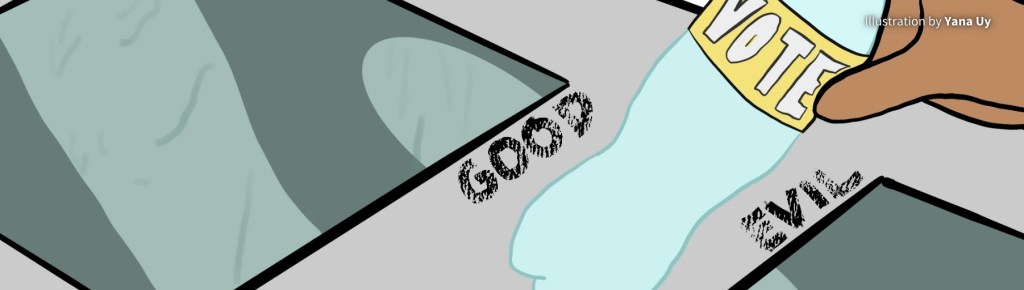
Collins’ Sunrise on the Reaping lays bare that President Snow’s mastery of propaganda, media control, and historical distortion isn’t just about maintaining power — it’s about eliminating choice. If the narrative is controlled, the people are controlled. And in the last two Philippine elections, the parallels are hauntingly clear. Through AI-generated campaigns, disinformation networks, and historical manipulation, the odds are stacked — never in favor of the many, but in favor of the few who hold the strings.
But the story doesn’t end there.
As Haymitch, Katniss, Peeta and the other victors who sparked the Mockingjay rebellion 25 years later proved, the force is always on the side of the governed. In the end, the Capitol fell when its version of reality could no longer hold. Because no matter how much they force-feed their lies as truth, there will always be those who are ready to spit them back. Perhaps the same could be true when we confront the political distortions of our own time.
Only when the truth breaks through, do the odds ever shift in our favor.

 SENTRO
Leave a comment