
Jeremy Ballesteros
It only took 10 minutes for 46-year-old Sitio Payong resident Marnie Mateo to get to her voting precinct for this year’s midterm elections.
What is usually a 20-minute trip to Old Balara Elementary School (OBES), was cut down in half thanks to a free transportation service provided by a non-political entity.
Sitio Payong, an urban poor community on the outskirts of Commonwealth Avenue in Quezon City, is located approximately 5.1 km from OBES. With the community situated away from the main roads, its residents relied on free jeepney and van services courtesy of different entities such as volunteers and politicians for 20 years.
While the rides are helpful for voters facing logistical and financial barriers, the Commission on Elections (COMELEC) reminded candidates that providing transportation services on election day is prohibited under Section 89 of the Omnibus Election Code.
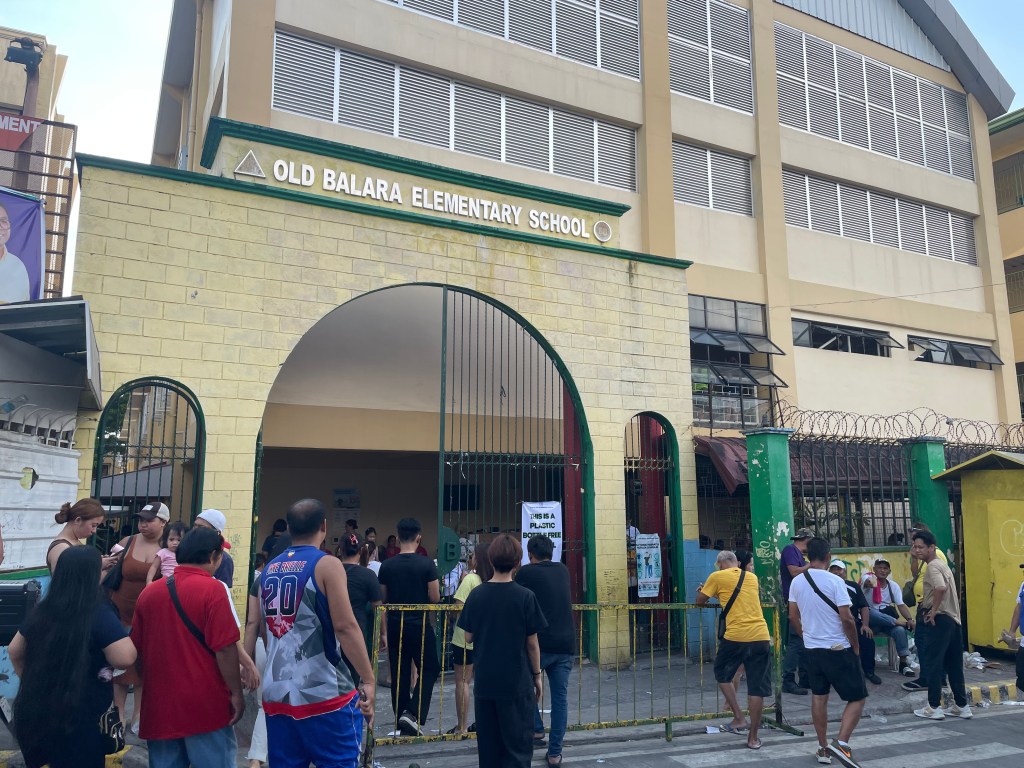
Voters flock to Old Balara Elementary School, the polling site of Sitio Payong residents. Photo by Elle Manlangit.
In the 2022 elections, Mateo voted at the same site — but the travel was far from easy.
After COMELEC’s warning, Mateo observed that the free ride services stopped. Residents of the remote Sitio Payong now had to find their own way to the precinct.
For some who don’t have the funds, voting becomes a privilege.
“Kasi ang layo. Unang-una, mamamasahe pa tapos boboto lang naman. Siyempre, kung yung iba walang pamasahe, hindi na boboto talaga. Kasi dalawang sakay, bali apat balikan. Yung iba naman, nagbibigay siya na ng service pero papunta lang doon. Tapos pagbalik, bahala na kayong mag-commute,” said Mateo in an interview with Sentro.
(It’s far. You have to spend on the commute when you’re just gonna vote. Of course, others who don’t have money won’t vote at all. Because it takes two rides, four in total. Sometimes there’s a free service, but it’s only to get to the site. It’s up to you to commute on your way home.)
Mateo and the other residents had an easier time getting to their voting precincts this year, but only because of a private transport service.
“Mas mabilis ang van kasi nasa halos 5 or 10 minutes andito na ang service. Kasi pag mag-commute ka, medyo matagal kasi maglalakad ka pa eh. Yan ang kaibahan,” the 46-year-old added.

Map shows Sitio Payong located behind an array of private subdivisions away from OBES, their voting site.
Sitio Payong is surrounded by multiple subdivisions, separating them from the main road where public transportation is available.
Jean Padpad, who has been a resident for 16 years, explained that due to their location, they have no other way of accessing the area besides passing through the gated villages of Capitol Homes and Loyola Grand Villas.
Their usual route is through Capitol Homes, where they either have to walk uphill or take private vehicles to get to Commonwealth Avenue. From there, they can finally ride jeepneys to get to the precinct.
Unlike other voters whose precincts are only a few minutes walk away, Sitio Payong residents have to walk for around an hour or take two rides — first using a tricycle, then a jeepney.

Tricycles line up at the entrance of Sitio Payong while waiting for passengers. Photo by Elle Manlangit.
Some residents use their own motorcycles, but access remains limited as curfews were set in place for the private villages. Motorcycles and tricycles are the residents’ main mode of transportation, but are only allowed to pass between 5:30 a.m. and 10 p.m.
Beyond those hours, only cars and pedestrians can pass, meaning that they either have to hail a taxi or walk the rest of the way.
“Diyan sa subdivision, basta naka-taxi pwede kang pumasok. Pero yung motor, tricycle — yung inaasahan — na mura ang maipapamasahe mo, yan yung hindi pwedeng maglabas-masok,” said Padpad.
(Anyone can pass through the subdivision as long as they’re riding a taxi. But the motorcycles, tricycles — the ones people depend on — which are affordable, those are the ones that can’t enter freely.)
“Ala-singko imedya pa nga pwedeng dumaan tricycle at mga motor. So kailangan nila maghabol ng oras. Kailangan alas 4 pa lang ang oras, lalabas na sila, maglalakad na sila,” she added.
(Tricycles and motors can only pass through at around five in the morning. So they have to move quickly. They have to leave their homes and start walking at four in the morning.)
Beyond the polls
To those in Sitio Payong, their transportation problem goes beyond just the day of the elections; this is a reality they face every day.
According to Padpad, students usually walk in the dark as tricycles aren’t allowed to pass through the village until 5:30 a.m. They have no choice but to start their day earlier to get to school on time for morning activities.
“Wala pang tricycle, eh. Bawal din yung mga single motor na yan na dumaan. Kaya maglalakad talaga. Yun lang ang pinaka-problema dito pagka-dating ng pasukan. Lalo yung ibang bata, may activity na maaga pa dapat. Kaya maglalakad talaga,” she explained.
(There are no tricycles yet. Motorcycles aren’t allowed either. So they really have to walk. That’s the biggest problem when the school year starts. Especially for the kids who have activities early in the morning. They really have to walk.)
It takes around 35 minutes to walk from their home to the main road where they can ride a jeepney to OBES, where most of their children study.
The same also goes for graveyard shift workers who arrive home outside curfew hours.
“Mga call center or ano, yung end ng pasok nila is alanganin. Lakad talaga, galing labas. O di kaya, mag-special taxi sila sa labas. Extra bawas dun sa sahod nila,” Padpad added.
(Those who work in call centers go home late. They have to walk from outside the subdivision. Otherwise, they have to take a taxi. It’s an additional expense from their income.)
Sitio Payong representatives have already communicated their concerns to the Old Balara Barangay, however, no new arrangements were made as they understood that the restrictions were made for the safety of the subdivision’s residents.
“Hindi naman namin pwedeng ipilit yung gusto namin na 24 hours kami pwedeng umano, kasi may karapatan din naman sila,” she said.
(We can’t impose the 24-hour access that we want because they have their rights as homeowners.)
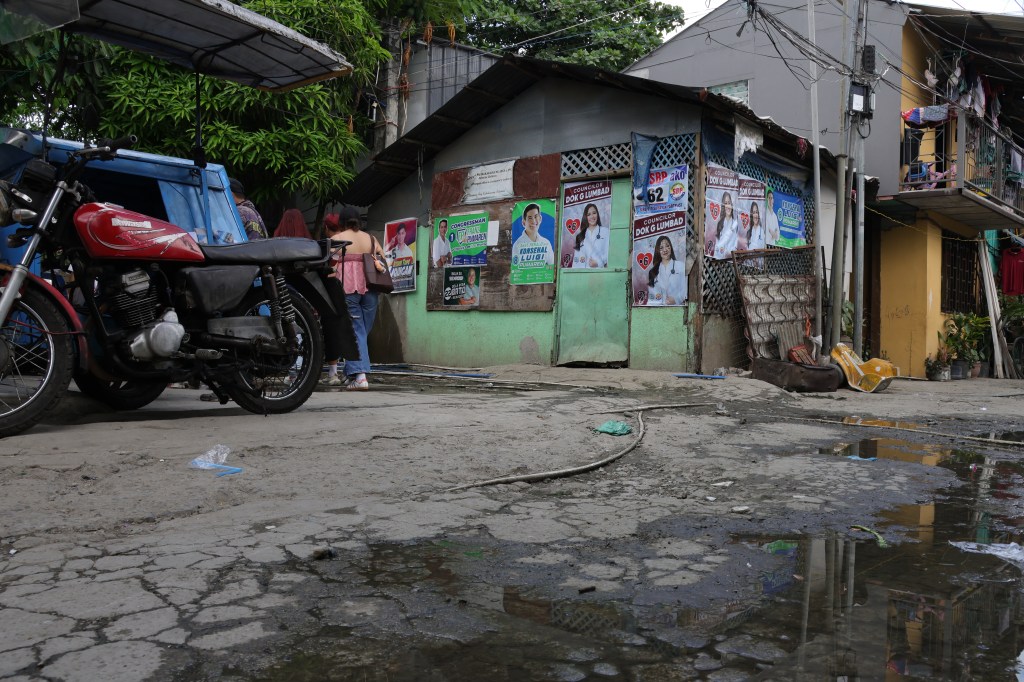
Campaign materials are posted outside the houses in Sitio Payong before the 2025 midterm elections. Photo by Jeremy Ballesteros.
Despite the difficulties in their travel, Sitio Payong residents ensure that they continue to exercise their right to vote for leaders who will serve their community.
“Syempre, mahalaga. Kasi unang-una, isa ako sa lalapit pag may kailangan sa gobyerno. Hindi naman natin masasabi na hindi natin sila kakailanganin. Kaya ako, para sa akin, talagang importante sa akin ang pagboto. At least makapili ako ng alam kong maayos siyang tumulong sa mamamayan,” Mateo said.
(Of course, it’s important. First of all, I’m one of the people who will ask the government for help. We can’t really say that we won’t need them. Personally, it’s really important to vote. At least I can choose someone who I know will be able to help the residents.)
To them, voting means more than just shading their ballots, it is also their way of fighting for access and inclusivity.
“Mahalaga din bilang isang Pilipino na maramdaman mo na isa ka, na parte ka ng mga ganoong activity. Maramdaman mo na isa kang Pinoy — na malaya ka. Nakakapamili ka rin ng mga taong hinalal mo, diba? At pag nanalo, masabi mo, ‘Uy, binoto ka yan, kasali ako dyan’,” Padpad said.
(As a Filipino, it’s also important to feel included in those activities. You will feel that you really are a Filipino — that you are free. You can choose who you want to elect, right? If they win, you can say that ‘I voted for him, I’m part of that’)



 SENTRO
Leave a comment